


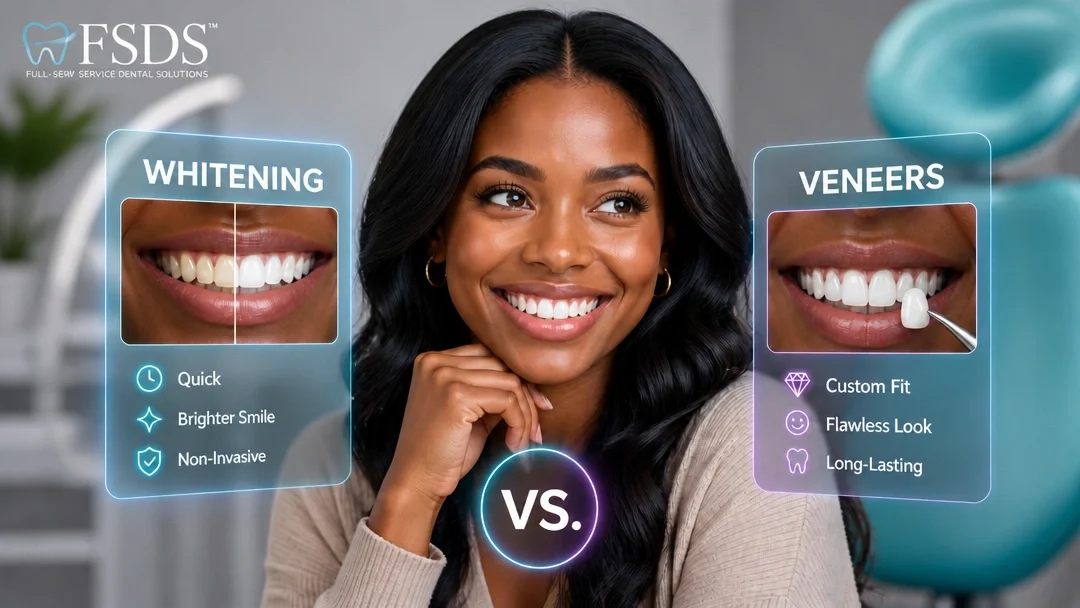
You know the moment. You’re brushing your teeth, you catch yourself in the bathroom mirror at a slightly too-honest angle, and suddenly you’re on your phone at 11 p.m. Googling “teeth whitening vs veneers.” Fifteen minutes later, you’ve landed on two options: professional teeth whitening and dental veneers. Both promise a better smile. Both have before-and-after photos that look genuinely impressive. And somehow, reading about them has made you more confused, not less.
Here’s the thing: these are not interchangeable options. They solve different problems, work through completely different mechanisms, and carry very different commitments. At Fancy Smiles Dental Studio in Boynton Beach, Dr. Francesca Scarlett walks patients through exactly this comparison on a regular basis. Her perspective, shaped by years of hands-on cosmetic dentistry experience, is simple: the right answer isn’t about which treatment sounds better. It’s about which one fits your specific teeth, your goals, and your life. This article is that conversation, written down. By the time you finish reading, you’ll know which direction makes sense for you and exactly what to ask when you sit down with a cosmetic dentist.
What teeth whitening and dental veneers actually do
Before comparing the two, it helps to have a clear picture of what each treatment actually involves. No technical jargon here, just a plain-spoken breakdown of what happens when you say yes to either option.
How professional whitening works
Professional teeth whitening uses either hydrogen peroxide or carbamide peroxide, a bleaching agent applied directly to the tooth surface. In-office sessions use higher-concentration formulas, often activated by an LED or laser light, and deliver visible results in about one to two hours. Dentist-prescribed take-home kits use custom trays with a lower-concentration gel that you apply over several weeks. Both methods work by lifting stains from the enamel surface. Neither one changes the underlying structure of your tooth in any permanent way.
What getting dental veneers involves
Veneers are thin shells, made from porcelain or composite resin, that are permanently bonded to the front surface of a tooth. Porcelain veneers require removing a small amount of enamel, typically between 0.3 and 0.7 millimeters, to ensure a proper fit and natural appearance. Composite veneers involve less or no enamel removal and are sculpted directly onto the tooth in a single visit. Here’s the part that matters most: because enamel doesn’t grow back, veneers are a permanent commitment. Once placed, that tooth will always need some form of covering. That’s not a reason to say no; it’s just information you deserve upfront. To understand more about porcelain options and their advantages, read our Benefits of Porcelain Veneers.
Why the type of staining you have changes everything
This is the most overlooked part of the teeth whitening vs veneers conversation, and it’s also the most important factor in choosing correctly. Before cost, before longevity, the first question is: what kind of staining do you actually have?
Surface stains respond well to professional whitening
Extrinsic discoloration, the kind caused by coffee, tea, red wine, and tobacco, sits on or near the enamel surface. Professional whitening was designed for exactly this type of stain. It lifts pigment from the enamel effectively and can produce noticeable results in a single session. If your teeth are structurally healthy but have gradually yellowed from years of morning coffee and the occasional glass of Cabernet, whitening is almost always the right starting point. It’s less invasive, more affordable, and genuinely effective for this category of discoloration.
Deep or internal staining usually requires veneers
Intrinsic discoloration originates inside the tooth, in the dentin layer, and many of these stains do not respond to conventional external bleaching. This category includes staining from tetracycline antibiotics (which causes gray or brown banding), fluorosis (white or brown spots from excess fluoride during tooth development), trauma to a tooth, and naturally dark dentin. It’s worth noting that specialized or prolonged professional bleaching protocols can help in some cases, particularly milder fluorosis or single-tooth discoloration following trauma, but severe intrinsic staining typically requires veneers or bonding to achieve a meaningful result. Veneers work for these cases because they mask the tooth’s surface entirely, regardless of what’s happening underneath. If you’ve tried whitening in the past and walked away disappointed, intrinsic staining is very often the reason why. That’s not a failure of effort; it’s a mismatch of treatment and problem.
Teeth whitening vs veneers: cost and longevity compared
Budget and longevity are two of the biggest factors people weigh when making this decision. Here are honest, specific numbers so you can plan with clarity rather than guesswork.
What professional whitening costs and how long it holds
In-office professional whitening in the U.S. in 2026 typically runs between $300 and $1,000 per session, with most practices charging between $400 and $800. Dentist-prescribed take-home kits range from $100 to $600. In-office results generally last one to three years depending on diet and habits; take-home kits often fall closer to the one-year mark. Touch-up frequency varies by patient and provider, some dentists recommend monthly home maintenance, while others suggest once or twice a year, so ask your dentist what protocol makes sense for your routine. The upfront cost is lower than veneers, but whitening is a recurring commitment rather than a one-time investment. Over five years, the math looks different than the initial price tag suggests.
What veneers cost and how long they hold
Porcelain veneers typically cost $900 to $2,500 per tooth in 2026, making a full-smile treatment a significant investment. Composite veneers are less expensive but also less durable, lasting five to seven years on average compared to the ten to fifteen years, often longer, that porcelain veneers can last with proper care. The higher upfront cost of porcelain reflects its longevity and stain resistance. When you run the numbers across a decade, the annualized cost difference between repeated whitening treatments and a single porcelain veneer placement is often narrower than people expect. If you want a deeper dive into whether veneers are a sensible financial and clinical choice for you, see our article Are Veneers Worth It? Cost, Longevity, and What to Expect.
Side effects, sensitivity, and what upkeep actually looks like
You deserve an honest picture of what each option feels like to live with, not just what it looks like on day one.
Whitening: temporary sensitivity, ongoing maintenance
Tooth sensitivity is the most common side effect of professional whitening, affecting roughly 57% of patients in clinical studies. It typically presents as sharp “zings” when consuming cold food or drinks and resolves within 24 to 48 hours. Gum irritation can occur if the bleaching gel contacts soft tissue and usually clears within one to three days. Maintenance requires avoiding staining foods for at least 48 hours after treatment and following your dentist’s recommended touch-up schedule to sustain results between full sessions.
If you have existing crowns, fillings, or bonding, this matters: whitening agents don’t change the color of dental restorations. Natural teeth will lighten while restorations stay the same shade, which can create a visible mismatch. This is a conversation worth having with your dentist before you start any whitening treatment.
Veneers: minimal bleaching sensitivity, different maintenance demands
Veneers don’t cause bleaching-related sensitivity, though the enamel reduction process can make teeth temporarily sensitive in the days before placement. Once bonded, veneers act as a protective outer layer. They require regular polishing at dental visits to keep their surface smooth and glossy, and they can chip or crack when exposed to hard foods or habits like nail-biting or chewing ice. One critical point: veneers do not respond to whitening agents. If natural teeth are whitened after veneers are placed, a color mismatch can result. Shade planning before placement is not just an aesthetic detail; it’s a long-term decision that matters.
Who is actually the right candidate for each option
This is where it all comes together. Here are two clear candidate profiles, read them and see where you land.
Professional whitening is likely your fit if:
- Your teeth are structurally sound with no significant chips, cracks, or shape concerns
- Your staining is extrinsic, from food, drinks, or tobacco use
- You want visible results without permanently altering your tooth structure
- Your budget is more limited and you’re comfortable with ongoing maintenance
- You want to see results before committing to a more involved cosmetic treatment
Veneers are likely your fit if:
- Your staining is intrinsic or hasn’t responded meaningfully to whitening
- You want to address shape, size, minor misalignment, or chips alongside color
- You’re looking for longer-lasting results and are comfortable with a permanent procedure
- You have a specific shade goal that goes beyond what bleaching can achieve
- You’re ready to invest more upfront for a result that holds for a decade or more
Neither profile is better than the other. They’re just different problems with different solutions. The key is matching the treatment to what your teeth actually need, not just what looks appealing in a before-and-after photo.
The next step is simpler than you think
There is no universally “better” option in the teeth whitening vs veneers decision. The right choice depends entirely on your stain type, your smile goals, your budget, and how you live day to day. A person with coffee staining and a healthy smile structure has a completely different answer than someone who tried whitening for months with no results because their discoloration is intrinsic. Both of those people deserve a clear path forward, and neither gets it from a Google search alone.
At Fancy Smiles Dental Studio, Dr. Francesca Scarlett and her team offer consultations for both professional teeth whitening and dental veneers. The goal of that conversation is never to sell you the most expensive option. It’s to look at your actual tooth structure, understand the type of discoloration you’re dealing with, and help you choose the treatment that genuinely fits your smile and your life, not just what sounds good on paper. If you’d like to schedule a consultation, connect with a Cosmetic Dentist in Boynton Beach, FL to get started.
If you’ve been sitting with that bathroom-mirror moment longer than you’d like, this is the step that turns it into a real answer. Reach out to Fancy Smiles Dental Studio in Boynton Beach and schedule a cosmetic consultation. You’ve already done the research. Now you just need someone to look at your teeth and tell you exactly what’s possible.