


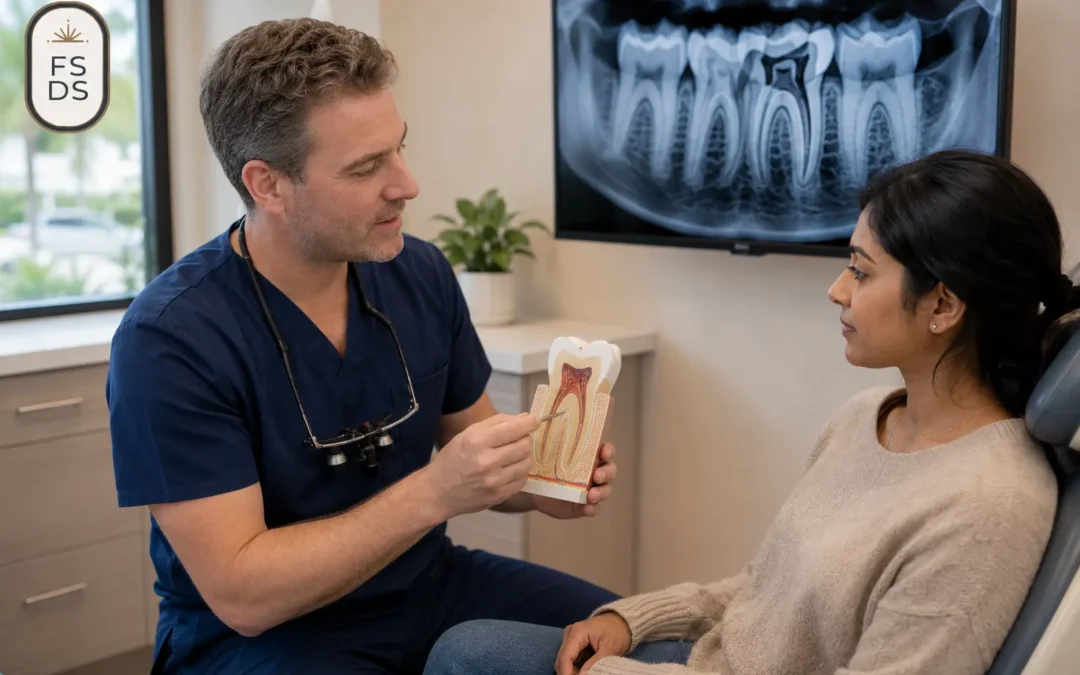
A deep, lingering ache or a jolt of pain when you drink something hot or cold is often a sign of nerve damage inside your tooth. So can a dentist fix nerve damage in your teeth? Here’s the honest answer: a badly damaged tooth nerve can’t be healed back to normal — but that almost never means losing the tooth. In most cases, a dentist can save it. Here’s how.
What “nerve damage” in a tooth actually means
Inside every tooth is a soft core called the pulp, which contains the nerve and blood supply. When deep decay, a crack, an injury, or repeated dental work lets bacteria or inflammation reach the pulp, the nerve becomes irritated or infected. That’s what people mean by a “damaged tooth nerve” — and it’s the source of that deep, hard-to-ignore pain.
Reversible vs. irreversible
Not all nerve irritation is permanent. Reversible inflammation — often just sensitivity — can settle down once the cause (like a cavity) is removed and the tooth is filled. Irreversible damage is different: once the pulp is inflamed or infected beyond a certain point, it can’t recover on its own, and leaving it untreated leads to infection, an abscess, or losing the tooth.
How a dentist fixes it: root canal therapy
For irreversible nerve damage, the standard treatment is a root canal. The dentist numbs the tooth, removes the damaged nerve and pulp, cleans and disinfects the inside of the roots, and seals it — usually finishing with a crown to protect the tooth. The tooth stays in place and functions normally; it simply no longer has a live nerve inside. Root canals have high, long-term success rates. Complex cases are often handled by an endodontist, a dentist who specializes in nerve and root problems.
Newer nerve-saving options
Dentistry has moved toward preserving as much of the tooth as possible. In carefully selected cases, techniques like vital pulp therapy or a pulpotomy remove only the damaged portion of the pulp and keep the healthy part alive. There’s also regenerative endodontics, a newer approach used mainly for immature adult teeth in children and teenagers. If a tooth is too far gone to save, extraction — followed by an implant or bridge — is the fallback.
Signs you shouldn’t ignore
Nerve problems tend to get worse, not better, so don’t wait out these symptoms:
- Pain that lingers for more than 30 seconds after hot or cold
- Spontaneous or throbbing pain, especially pain that wakes you at night
- A pimple-like bump on the gum, swelling, or a bad taste — possible signs of an abscess
- A tooth that’s darkened compared to those around it
Getting seen early often means a simpler fix and a better chance of saving the tooth.
Frequently Asked Questions
1. Can a damaged tooth nerve heal on its own?
Mild, reversible irritation can calm down once the cause is treated. But once the nerve is irreversibly damaged, it won’t heal — it needs treatment to prevent infection and save the tooth.
2. Does fixing nerve damage mean losing the tooth?
Usually the opposite. A root canal is specifically designed to save a tooth with a damaged nerve. Extraction is only a last resort when the tooth can’t be saved.
3. Is a root canal painful?
Modern root canals are done under local anesthesia and are typically no more uncomfortable than a filling. Most people feel relief afterward, because the source of the pain is gone.
4. What happens if I ignore a damaged tooth nerve?
The infection can spread, form an abscess, and lead to tooth loss — and in some cases become a more serious health problem. Prompt treatment is much easier and safer than waiting.
If you’ve got lingering tooth pain, sensitivity, or swelling, don’t tough it out. The team at Fancy Smiles Dental Studio in Boynton Beach can pinpoint the problem and, in most cases, save your tooth — schedule an appointment before a small issue becomes a big one.