


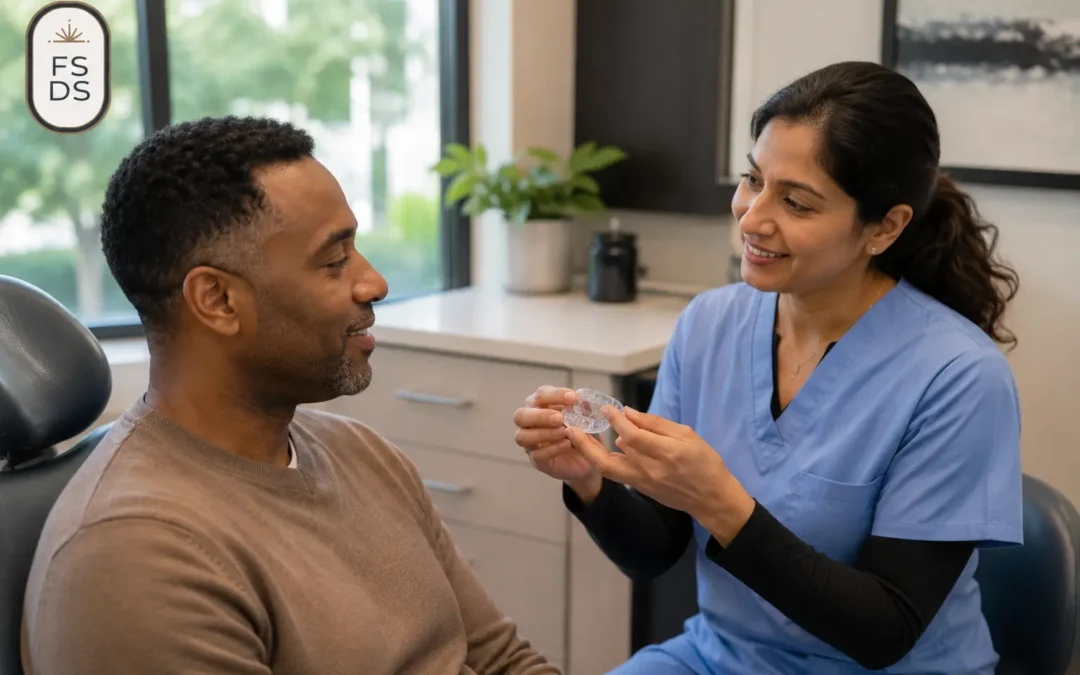
If you snore loudly, wake up gasping, or feel exhausted after a full night’s sleep, sleep apnea may be the reason — and your dentist may be part of the solution. It surprises a lot of people, but treating obstructive sleep apnea isn’t only a job for sleep labs and CPAP machines. Dentists play a real, established role.
There’s one important rule first: a dentist can treat sleep apnea, but a dentist can’t diagnose it. Here’s how that works, what a dental appliance actually does, and how to tell whether it’s right for you.
What Is Obstructive Sleep Apnea?
Obstructive sleep apnea (OSA) happens when the soft tissues at the back of your throat relax and collapse during sleep, briefly blocking your airway. Breathing stops and starts, oxygen dips, and your brain nudges you awake — often hundreds of times a night without you remembering. Common signs include loud chronic snoring, gasping or choking during sleep, morning headaches, dry mouth, and daytime fatigue or brain fog. Left untreated, OSA is linked to high blood pressure, heart problems, and other serious health risks, according to the National Heart, Lung, and Blood Institute.
Can a Dentist Actually Treat Sleep Apnea?
Yes — through oral appliance therapy. Once you’ve been diagnosed by a sleep physician, a dentist trained in dental sleep medicine can fit you with a custom oral appliance that keeps your airway open while you sleep. The key word is diagnosed: sleep apnea must be confirmed by a qualified sleep doctor through a sleep study or an at-home sleep test. Your dentist works alongside that physician — handling the appliance side, not the diagnosis.
How Oral Appliance Therapy Works
The most common device is a mandibular advancement device (MAD). It looks a bit like a sports mouthguard or a set of retainers and works by gently holding your lower jaw and tongue slightly forward. That small shift keeps the soft tissue at the back of your throat from collapsing, so your airway stays open and air keeps flowing. Because it’s custom-made from impressions of your teeth, it’s far more comfortable and effective than any one-size-fits-all device from a drugstore.
Oral Appliance vs. CPAP: How They Compare
CPAP — the mask-and-machine that pushes pressurized air into your airway — is still the gold standard, especially for severe apnea. But it isn’t the only option, and it isn’t right for everyone:
- Effectiveness: CPAP controls apnea more completely per night, but many people can’t tolerate the mask and stop using it. Because an oral appliance is easier to stick with, real-world outcomes often end up similar.
- Comfort and convenience: An oral appliance is small, quiet, needs no power, and travels easily — no mask, hose, or motor.
- Best fit: Sleep specialists often recommend an oral appliance for people with mild to moderate OSA, or for those with more severe apnea who can’t tolerate or don’t want CPAP.
Who’s a Good Candidate?
Oral appliance therapy tends to be a strong fit if you have mild to moderate obstructive sleep apnea, you’ve tried CPAP and couldn’t stick with it, or you’re a heavy snorer whose sleep study confirms apnea. It’s not a do-it-yourself fix — an over-the-counter “anti-snore” mouthpiece can mask symptoms while leaving the underlying apnea untreated, which can be dangerous. A proper diagnosis and a custom, dentist-fitted device make all the difference.
What to Expect at the Dentist
After your sleep physician confirms the diagnosis, your dentist will examine your teeth, gums, and jaw and take impressions or digital scans to build a device that fits you precisely. Once it’s ready, you’ll wear it nightly, and your dentist will fine-tune the fit over a few visits to balance comfort with results. Your sleep doctor may order a follow-up sleep test to confirm the appliance is working. Your dentist will also monitor for side effects — like temporary jaw soreness, bite changes, or tooth shifting over time — and adjust as needed. It’s a team effort between you, your dentist, and your sleep physician.
Frequently Asked Questions
1. Can my dentist diagnose sleep apnea?
No. A dentist can screen for warning signs and refer you, but a formal diagnosis has to come from a sleep physician via a sleep study or at-home sleep test. Once you’re diagnosed, your dentist can treat it with an oral appliance.
2. Is an oral appliance as good as a CPAP?
For mild to moderate sleep apnea, it can be very effective — and because it’s easier to use consistently, results are often comparable to CPAP in everyday life. For severe apnea, CPAP is usually the first choice, but an appliance is a valuable alternative when CPAP isn’t tolerated.
3. Will insurance cover an oral appliance?
Often, yes. Because it treats a diagnosed medical condition, oral appliance therapy is frequently covered under medical insurance rather than dental. We can help you understand your options before you commit.
4. Are drugstore anti-snoring mouthpieces the same thing?
No. Over-the-counter devices aren’t custom-fitted and can shift teeth or mask untreated apnea. A dentist-made appliance is built from scans of your mouth and managed alongside your medical care.
5. Does an oral appliance stop snoring too?
Usually, yes — by keeping your airway open, it reduces or eliminates the snoring that often comes with sleep apnea, which tends to help your partner sleep better as well.
If you’re snoring, waking up tired, or already have a sleep apnea diagnosis and dread your CPAP, an oral appliance may be worth exploring. The team at Fancy Smiles Dental Studio in Boynton Beach can walk you through your options and coordinate with your sleep physician — schedule a consultation to get started.