


You’ve been meaning to schedule a dental cleaning for, oh, six months, okay, maybe fourteen, and life just keeps happening. The kids need something. Work piles up. The appointment feels optional in a way that, say, a root canal doesn’t. And somewhere in the back of your mind, you figure your teeth are probably fine because nothing hurts.
Here’s what most people don’t realize: the dental cleaning benefits from that 45-minute chair visit go well beyond making your teeth feel smooth and your breath smell like mint. There’s real clinical science behind what happens during a routine cleaning, and it extends far beyond the polish. At Fancy Smiles Dental Studio in Boynton Beach, FL, some patients tell us they had no idea a cleaning covered so much ground, and that getting back on schedule was easier on their wallet than they expected.
This article covers what actually happens during a cleaning, the oral health benefits most people underestimate, the surprising whole-body connections dentists keep mentioning, and what to do if cost has been the reason your appointment keeps getting pushed to “next month.”
What actually happens during a dental cleaning
The step-by-step of a standard visit
A standard cleaning appointment typically runs 30 to 60 minutes for a healthy mouth. It starts with an oral exam: your hygienist or dentist uses a small mirror to check your teeth and gums, measures gum pocket depths with a probe, and takes X-rays if they’re due. This part sets the stage for everything that follows.
Next comes scaling, where plaque and tartar are removed using hand instruments or an ultrasonic scaler. You’ll hear scraping sounds and feel a buzzing sensation from the polisher, both completely normal, not a sign anything is wrong. After scaling, your teeth get polished with a slightly gritty paste. The hygienist flosses between each tooth, you rinse, and a fluoride treatment is applied if recommended. Simple, systematic, effective.
Routine cleaning vs. deep cleaning: knowing the difference
A standard prophylaxis, the routine cleaning most people get twice a year, is a preventive procedure. It targets plaque and tartar above and just slightly below the gumline in patients whose gums are healthy. Think of it as maintenance: you’re staying ahead of problems before they start.
Scaling and root planing (SRP), often called a deep cleaning, is something different. It’s a therapeutic procedure for active gum disease. It cleans well below the gumline and smooths root surfaces so inflamed gum tissue can heal and reattach. Whether you need one or the other isn’t determined by how your mouth feels; it’s determined by what the dentist actually finds during your exam. Gum disease rarely hurts until it’s well advanced, which is exactly why the exam matters.
Dental cleaning benefits for your core oral health
Removing what brushing and flossing can’t reach
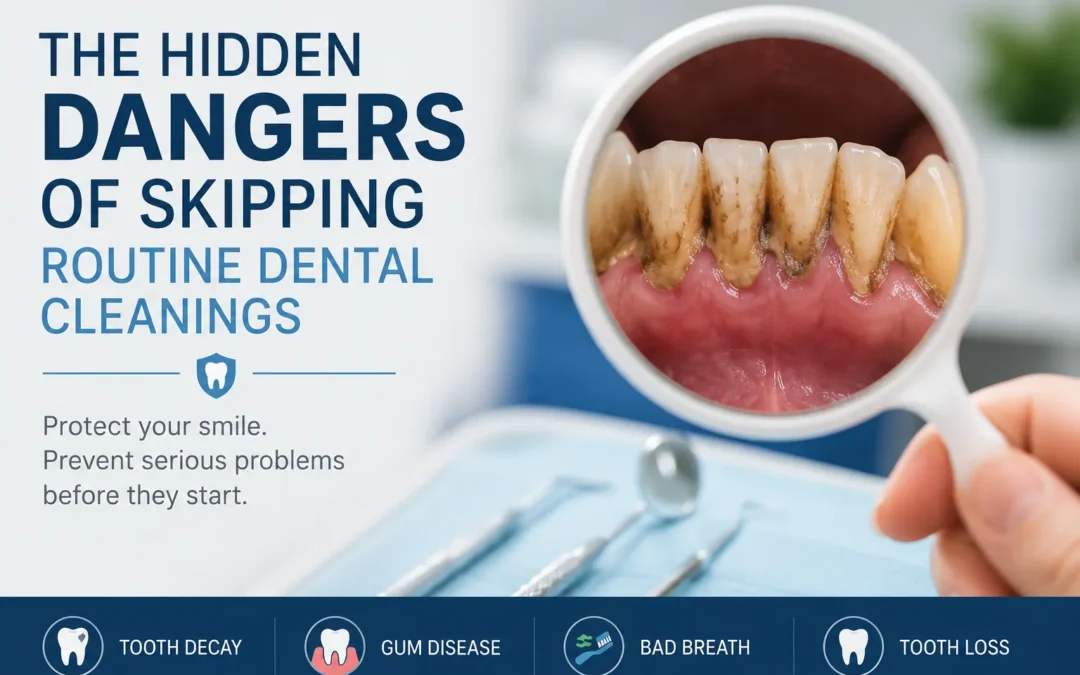
Tartar, also called calculus, is hardened plaque. Once plaque mineralizes, it bonds to tooth surfaces in a way that no toothbrush or floss can dislodge. It accumulates especially along the gumline and between teeth, exactly where gum disease tends to start. Only professional instruments can remove it.
The reason this matters is that tartar is a bacterial reservoir. It drives chronic inflammation in the gum tissue, the underlying mechanism behind both cavities and periodontal disease. Professional debridement removes that buildup and reduces local inflammation, giving your immune system meaningful relief. Research supports that this kind of professional cleaning also lowers measurable inflammatory markers in the body, more on that in the whole-body section below. If you’re weighing at-home fixes against clinical care, our piece on home remedies vs professional treatments explains why professional removal is often the missing link. For a detailed look at the broader advantages, see this article on the .
Catching problems early before they get expensive
Every cleaning includes a clinical exam, and that exam is where small problems get caught before they become large ones. A cavity spotted early is a one-visit filling. The same cavity left alone for another year may become a crown. Left another two years, it may require a root canal or extraction, along with the cost and complexity those procedures bring.
Early detection is both the physical and financial case for never skipping a cleaning. Cracked restorations, early gum recession, bite issues, and signs of oral cancer are all part of what your dentist is looking for while you’re in the chair. It’s a lot of ground covered in under an hour.
Gum disease prevention and what’s at stake
Gingivitis is the early, reversible stage of gum disease, inflammation caused by bacterial buildup that the gums can recover from once the bacteria are removed. Periodontitis is a different story. It’s progressive, largely irreversible, and involves actual bone loss around the teeth. Routine professional cleanings are one of the most reliable tools for keeping patients in the gingivitis stage, or out of it entirely.
According to the CDC and American Dental Association, gum disease is the leading cause of tooth loss in adults, and the majority of cases are preventable with consistent care. Staying on schedule isn’t about fear, it’s just about keeping a condition at bay that’s genuinely common and genuinely avoidable.
The dental cleaning benefits most patients never expect
Fresher breath that actually lasts
Chronic bad breath (halitosis) is largely driven by sulfur-producing bacteria that accumulate in plaque and tartar deposits. Home brushing helps manage it, but it doesn’t fully clear the bacterial colonies living in hardened buildup. A professional cleaning removes those deposits, giving your breath a genuine reset that mouthwash simply can’t replicate. For patients who brush twice a day and still notice persistent odor, this is often the missing piece.
Oral cancer screening is part of every visit
Most patients are surprised to learn that a soft tissue exam is a standard part of every cleaning appointment. Your dentist checks the tongue, cheeks, floor of the mouth, throat, and lips for any unusual changes: patches, sores that haven’t healed, asymmetry, or abnormal texture. Lymph nodes and jaw areas are also palpated for swelling.
According to the American Cancer Society, the five-year survival rate for oral cancer caught at an early, localized stage is significantly higher than for cancers diagnosed after they’ve spread, making routine screening far more than a formality. The fact that this check is woven into every visit is one of the most underappreciated dental cleaning benefits, and most patients walk out not even realizing it happened.
Surface stain removal that comes standard
The polishing step removes extrinsic stains from coffee, tea, and wine without any whitening agents. This isn’t a cosmetic add-on; it’s part of every standard cleaning. You leave with visibly brighter teeth, a natural result of having surface biofilm and staining cleared away. Patients who’ve been skipping visits often notice the most dramatic difference here, simply because the buildup had more time to accumulate.
The whole-body health connection dentists keep talking about
What research says about cleanings and heart health
The link between gum disease and cardiovascular risk is one of the most studied associations in dental medicine. The core mechanism: oral bacteria can enter the bloodstream through inflamed gum tissue, contribute to arterial inflammation, and have been found in atherosclerotic plaque. A of a study published in the European Heart Journal found that getting at least one dental cleaning per year was associated with a 14% lower risk of cardiovascular events compared to never going.
To be clear about what the evidence does and doesn’t say: the American Heart Association acknowledges the association between gum disease and heart disease but stops short of claiming that cleanings directly prevent heart attacks. The association is real and consistent; causation is still being studied. Knowing that distinction is more useful than overstating the claim, and it’s still a meaningful reason to stay on schedule. For readers interested in recent peer-reviewed work on oral-systemic links, this explores inflammatory pathways that help explain those associations.
Oral health’s role in diabetes and systemic inflammation
The relationship between gum disease and diabetes runs in both directions. Gum disease makes blood sugar control harder, and poorly controlled diabetes makes gum disease more difficult to manage. Professional cleanings reduce chronic oral inflammation and have been shown in peer-reviewed research to lower systemic inflammatory markers such as C-reactive protein (CRP), which can help interrupt that cycle and makes them especially important for patients managing diabetes.
Professional cleanings support overall health; they’re not a cure for systemic disease. But reducing chronic inflammation in the mouth is a meaningful piece of a larger wellness picture, and it’s one of the simplest interventions available.
How often to go and when you might need more than a routine cleaning
Setting your cleaning schedule based on actual risk
The ADA doesn’t set a single universal cleaning interval for all adults. Twice a year works well for most people with healthy mouths. But smokers, diabetics, patients with a history of gum disease, and those who build tartar quickly often need cleanings every 3 to 4 months to stay ahead of disease progression.
Ask your dentist to set a personalized schedule based on what they find at your exam, rather than defaulting to “whenever I remember.” Your mouth’s needs aren’t identical to your neighbor’s, and your cleaning schedule shouldn’t be, either.
Warning signs that a routine cleaning won’t be enough
If your gums bleed consistently when you brush or floss, you have persistent bad breath, or your gums look like they’re pulling away from your teeth, these are red flags that gum disease may already be present. Deep gum pockets (4mm or more), visible tartar buildup at the gumline, or bone loss visible on X-rays typically indicate that scaling and root planing is needed rather than a standard prophylaxis.
Needing a deep cleaning isn’t a personal failure; it’s a treatable condition. Getting it addressed stops the damage from progressing and gets you back into a preventive maintenance schedule. The earlier it’s caught, the better the outcome.
Making preventive dental care work on any budget
Why skipping a cleaning is one of the more expensive decisions you can make
About 65% of American adults without dental insurance report skipping dental visits because of cost. That’s a real and understandable barrier, and it deserves a direct response rather than a lecture. A routine cleaning without insurance typically runs $75 to $200 depending on the office and location. Treatment for advanced decay, root canals, extractions, crowns, or implants, can run substantially more, and that gap only widens the longer care is delayed. The professional teeth cleaning benefits you get for that $75 to $200 are genuinely hard to match dollar for dollar anywhere else in healthcare. National surveys such as the document how cost triggers skipped care for many adults.
In-house membership plans remove the financial obstacle
For uninsured patients in Boynton Beach and the surrounding Palm Beach County area, Fancy Smiles Dental Studio offers an in-house dental savings plan designed to make preventive care accessible without the complexity of traditional insurance. Plan options cover cleanings, exams, and X-rays with no waiting periods and no claims to file, plus a discount on any additional treatments you need during the year. Contact the office directly for current plan pricing and details.
No waiting periods. No surprise bills. No reason to keep pushing that appointment back. It’s a straightforward annual membership that covers the preventive foundation your oral health needs and makes it easy to stay on schedule year after year.
Your mouth is worth the 45 minutes
Now that you know what a cleaning actually covers, skipping one looks a little different. In under an hour, you get tartar removal that home care can’t replicate, early detection of problems that are far cheaper to fix now, fresher breath that lasts, a built-in oral cancer screening, and a measurable reduction in the systemic inflammation that affects your whole body. The dental cleaning benefits packed into one appointment are genuinely hard to overstate.
If cost has been the reason you’ve been waiting, it’s worth asking whether an in-house membership plan at Fancy Smiles Dental Studio makes the numbers work for you. And if it’s been a while and you’re not sure what to expect, that’s exactly the kind of thing we walk patients through every day, gently, thoroughly, without judgment. You can also find more practical patient information on the Fancy Smiles Dental Blog.
Your mouth is one of the clearest indicators of your overall health, and a professional cleaning is one of the most effective ways to protect it. The team at Fancy Smiles Dental Studio is here whenever you’re ready to get back on track. Book your appointment today, we’d love to see you.