


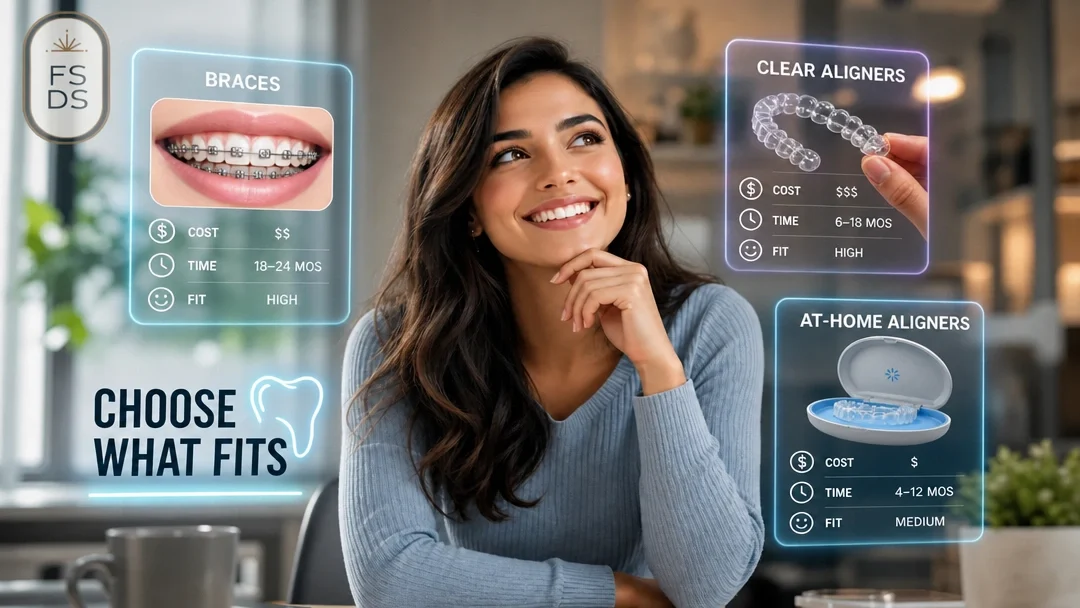
More options should make a decision easier. With teeth straightening, they somehow make it harder. With so many teeth straightening options available, patients walk into the consultation room at Fancy Smiles Dental Studio knowing they want straighter teeth and having done hours of research online, but still feeling completely lost because every source seems to push something different. Metal braces, clear aligners, lingual braces, at-home kits, veneers, the list keeps growing, and so does the confusion.
The real problem isn’t a lack of information. It’s that most of that information skips the part you actually need: which option matches your specific alignment issue, your budget, your timeline, and how you actually live your life. This article cuts through all of that. By the end, you’ll know what each option does, what it costs in 2026, how long it takes, and which one makes sense for your situation.
The main teeth straightening options, explained plainly
All braces work the same way at a mechanical level: brackets bonded to teeth connect to a wire, and that wire applies constant pressure to shift teeth gradually over time. What varies is the material, placement, and price. Metal braces are the most affordable and the most effective across a wide range of severity levels. They’re highly visible, but they’re the most reliable option for a wide range of problems, including many severe cases. The most complex skeletal issues may still require surgery in addition to braces. Ceramic braces use the same mechanics with tooth-colored brackets, making them less noticeable, though the brackets can stain with coffee or red wine and are more brittle than metal. Lingual braces attach behind the teeth rather than in front, making them invisible from the outside. The trade-off: they’re the most expensive option, harder to clean, and often cause a temporary lisp.
Clear aligners work differently. Instead of brackets and wires, they use a series of removable plastic trays worn 22 hours a day. Each tray shifts teeth by roughly 0.1 to 0.2mm before the patient switches to the next set every two weeks. In-office aligners (the Invisalign-style treatment provided by a licensed dentist or orthodontist) come with X-rays, clinical monitoring, and professional adjustments. At-home mail-order aligners skip all of that, which is precisely where the risk lives. The American Association of Orthodontists has surveyed its member orthodontists and found that the majority have treated patients requiring retreatment after using mail-order kits; documented outcomes include gum recession, bone loss, and permanent tooth loss. Lower upfront cost may be outweighed by the higher risk of complications and potential retreatment costs in many cases.
Veneers and dental bonding occupy a completely different category. They don’t move teeth at all. Porcelain veneers are thin shells bonded to the front of teeth to mask crookedness and improve color. Bonding reshapes teeth with a resin material to close gaps or create a straighter appearance. These are cosmetic tools, not orthodontic ones, and they’re only appropriate when bite function is already healthy and the concern is purely aesthetic.
Teeth straightening options compared: which problems each treatment can actually fix
Clear aligners perform well on mild to moderate crowding, small gaps, minor overbite, minor crossbite, and straightforward open bite cases. Clinical data generally puts their success rate at 80 to 90 percent for mild to moderate problems, but that success depends entirely on consistent 22-hour daily wear. Clear aligners are not a shortcut or an easier path. They’re a highly effective tool in the right cases and genuinely ineffective in the wrong ones. Severe crowding requiring extractions, large gaps, significant underbite, and complex Class III malocclusion fall outside their reliable range. Malocclusion Treatment | Fancy Smiles Dental Studio
Traditional braces carry a greater than 90 percent success rate across all severity levels, including cases that require extractions or additional appliances. When combined with jaw surgery for the most complex structural problems, success rates climb to around 94 percent. The severity of your misalignment is the single most important factor in determining which treatment will actually work, not what looks best in photos or what costs less upfront. Lingual and ceramic braces can treat the same range of problems as metal braces; they just add aesthetic comfort at a premium.
Veneers and bonding make sense when bite function is solid and the concern is a minor visual one: slightly uneven teeth, a small gap, or surface-level crookedness. No dentist worth trusting will recommend veneers as a substitute for orthodontic treatment when a real alignment issue exists. A proper exam always comes first.
What each option actually costs and how to manage the bill
Here’s a straightforward breakdown of what you’re looking at in 2026 across Florida and the broader U.S. market. Metal braces typically run $3,000 to $7,000, making them the most budget-friendly orthodontic option. Ceramic braces come in at $4,000 to $8,500. In-office clear aligners range from $3,000 to $8,000 depending on complexity, though Florida patients may see costs toward the higher end of that range given regional market variation. Lingual braces carry the highest price at $8,000 to $13,000, driven by custom manufacturing and the specialized placement skill required. At-home aligners are typically priced between $1,800 and $3,500 for entry-level programs, though some providers charge considerably more, and they’re limited to very mild cases with the documented risks described above. Cosmetic veneers run $2,000 to $5,000 per tooth, and dental bonding is less expensive but is also a per-tooth fee.
Insurance coverage splits sharply by age. Children under 18 typically see their plans cover 50 percent of orthodontic costs up to a lifetime maximum of $1,000 to $3,000. Most adult dental plans offer no orthodontic coverage at all, so adults in Florida should plan to pay the full amount unless their specific plan includes a rare orthodontic benefit. Financing makes this workable for most budgets. In-house monthly plans at practices like Fancy Smiles Dental Studio often run $89 to $250 per month at zero interest. CareCredit, HSA and FSA accounts, and paid-in-full discounts (some practices offer around 5 percent off) are additional tools worth asking about.
How long treatment takes and what comes after
Metal braces average 18 to 24 months, extending to 36 months in complex cases. Ceramic braces run roughly 18 to 36 months, slightly longer due to bracket fragility. Lingual braces average 24 to 36 months. In-office clear aligners typically take 12 to 24 months for adults, and as little as 6 to 18 months for simpler cases. Cosmetic veneers are completed in two to three dental appointments over a few weeks, though the natural teeth underneath still require regular ongoing care.
Retention is the step almost everyone underestimates, and skipping it is the most common reason patients lose their results. After any orthodontic treatment, teeth will shift back without retainers. Current orthodontic guidelines recommend full-time retainer wear for at least the first 3 to 6 months after treatment, followed by nightly wear indefinitely. That “indefinitely” part is not a sales pitch, teeth shift naturally throughout life even without prior treatment, and nightly retainer wear is the only way to protect the investment. Fixed (bonded) retainers, which attach behind the front teeth and stay in place continuously, are a good option for patients who know they won’t be consistent with a removable retainer. Both types work; the key is choosing one and sticking to it.
Daily life with each option: visibility, hygiene, and what to watch for
Metal braces are the most noticeable option and require the most dietary discipline. Hard foods, sticky foods, and anything that can get lodged in brackets need to go. Monthly adjustment appointments are mandatory, and brushing after every meal with interdental tools is non-negotiable to prevent enamel demineralization. Ceramic braces follow the same hygiene rules, with the added concern of staining from coffee and red wine. Lingual braces are invisible from the front but introduce a temporary lisp for most patients, cause early gum irritation, and are genuinely difficult to clean given their placement behind the teeth.
Clear aligners have real lifestyle advantages: nearly invisible, removable for meals, no food restrictions. But the hygiene requirement is strict. Teeth must be brushed before reinserting aligners every single time; otherwise, the trays trap bacteria against the tooth surface and gum disease can follow. Aligners need daily rinsing with cool water (hot water warps the plastic and ruins the fit) and a soft toothbrush cleaning. At-home aligners carry all of these hygiene requirements plus the significant added risk of no clinical oversight: no X-rays, no gum disease screening, no in-person monitoring. Documented outcomes from these kits include gum recession, bite changes, loose teeth, and irreversible damage, problems that cost far more to fix than the original treatment would have.
How to choose the right teeth straightening option and where to start
A few questions narrow this down fast. How severe is your misalignment: mild, moderate, or significant? Are you dealing with an actual bite issue (overbite, underbite, crossbite) or is this purely cosmetic? How much daily compliance can you honestly commit to? Clear aligners require 22 hours of wear daily, that’s the real requirement, not a suggestion, and results suffer if it’s treated as optional. Do you have a timeline deadline, like a wedding or event? Are you looking at treatment for a child with a still-developing jaw, or for an adult?
None of these questions can be answered accurately without a clinical exam. A proper evaluation includes a full review of your bite function, X-rays, and assessment of gum health. At Fancy Smiles Dental Studio in Boynton Beach, FL, Dr. Francesca Scarlett evaluates both adult and pediatric patients for the full range of orthodontic solutions, developing treatment plans tailored to each patient’s alignment needs, bite health, and lifestyle. Treatment planning is fully transparent, and the practice offers an in-house membership plan for uninsured patients, ask at your consultation about current pricing and what it covers.
No article, quiz, or mail-order kit replaces a clinical assessment with X-rays. The information here is a starting point. Your consultation is where the real answer lives, and you’ll leave knowing exactly what your teeth need, what it will cost, and what the path forward looks like.
The bottom line on teeth straightening options
Choosing among teeth straightening options comes down to three things: the severity of your misalignment drives which treatments will actually work, your budget and timeline determine what’s realistic, and your lifestyle determines whether you’ll follow through. Someone who won’t consistently wear aligners for 22 hours a day isn’t a candidate for clear aligners, regardless of how appealing they seem. Someone with a severe Class III malocclusion isn’t a candidate for at-home kits, regardless of how affordable they look.
Skipping professional evaluation is one of the most expensive mistakes in this process. At-home options and cosmetic workarounds can create complications that cost significantly more to address than the original problem would have, a pattern that AAO member surveys and retreatment data consistently bear out. The patients who end up spending the most on their teeth are usually the ones who tried to spend the least at the start.
If you’re in Boynton Beach or anywhere in Palm Beach County and ready to find out which teeth straightening options fit your specific situation, a consultation with Fancy Smiles Dental Studio is the right first move. You’ll leave with a clear picture of what your teeth actually need, what it will cost, and what the path forward looks like, no guesswork, no surprises.