


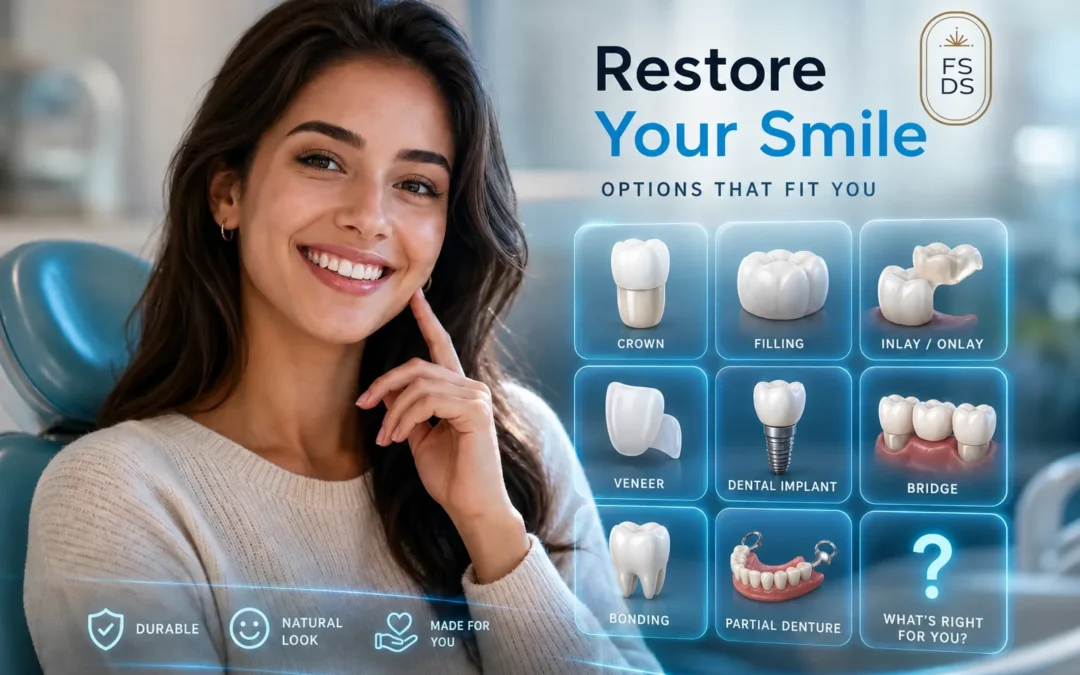
When your dentist says “you’re going to need some work done,” understanding your tooth restoration options makes a big difference in time, cost, and recovery. The words “crown,” “implant,” and “root canal” get thrown around, and without context, all of them sound equally alarming.
The good news is that restorative dentistry isn’t one-size-fits-all. It’s a toolbox, and each tool is designed for a specific problem. At Fancy Smiles Dental Studio, one of the most common questions patients ask before any treatment is, “Do I actually need all of this?” Understanding your options changes that conversation completely. You go from anxious to informed, and that makes a real difference in the decisions you make.
This guide covers all nine tooth restoration options, what each one treats, what to expect in cost and recovery, and the questions worth asking before you say yes to any treatment plan.
Tooth restoration options: conservative repairs for teeth that are damaged but still mostly intact
The most common restorative dentistry procedures are also the least invasive. When a tooth is compromised but structurally sound, the goal is to fix the damage without removing more structure than necessary. Three options fall into this category: fillings, dental bonding, and inlays or onlays. If you’d like an overview of our broader approach to restoring teeth in the area, see our Restorative Dentistry in Boynton Beach.
1. Fillings
Fillings are the starting point for cavities and minor fractures. The process involves removing decayed material, cleaning the area, and packing it with either composite resin (tooth-colored) or amalgam (silver-colored). The whole thing is done in a single visit, and you’re numb throughout.
Composite resin is the material most commonly used today because it blends with your natural tooth color. Amalgam is more durable but visible, so it’s typically reserved for back teeth. Composite fillings last five to ten years; amalgam can stretch to ten to fifteen. The most common failure mode for either is secondary decay forming underneath the filling over time. In Florida, composite fillings average around $226, depending on tooth size and material.
2. Dental bonding
Bonding applies composite resin directly to chips, cracks, or stained areas to restore appearance. It’s one of the fastest and most affordable restoration options for teeth in the repair category, completed in a single visit with no lab work involved. The trade-off is durability: bonding isn’t as strong as lab-fabricated restorations and is best suited for cosmetic concerns rather than structural ones.
3. Inlays and onlays
These fill the gap between a standard filling and a full crown. An inlay fits within the grooves between the cusps of a damaged tooth. An onlay extends over one or more cusps to cover a larger portion of the chewing surface. Both are fabricated outside the mouth in a lab, then cemented in, which makes them more durable and better fitting than a direct filling.
Standard practice draws a clear line here: if the damage is too large for a filling but not severe enough to warrant a crown, an inlay or onlay is the right call. Most cases require two visits, though some practices with in-office CAD/CAM technology can complete them in one. For a deeper comparison of dental inlay vs onlay, reputable patient resources outline the pros and cons of each approach.
Full-tooth protection: crowns and root canal treatment
When a tooth needs to be fully encased or when infection has reached the inner pulp, you’re moving into a different category of care. These procedures are more involved, but they’re also how dentists save teeth that might otherwise need to be pulled. For many patients, this is the difference between keeping a tooth and losing it entirely.
4. Dental crowns
A crown is a cap placed over the entire visible portion of a tooth. It restores shape, size, and function when a tooth is too damaged to hold a filling, has fractured, or has been significantly weakened by previous dental work. Crowns are also placed over implants and root canal-treated teeth.
Zirconia is increasingly the preferred material because it’s strong, natural-looking, and long-lasting. Other options include porcelain-fused-to-metal (PFM), all-ceramic, and gold. In Florida, crown costs range from $1,000 to $2,500 depending on material. For additional reading on material choices and restoration types, helpful summaries of the types of dental restorations explain how materials affect durability and aesthetics. With proper care, a well-placed crown can last 15 to 20 years or longer. The process typically takes two visits: one to prepare the tooth and place a temporary, and a second to bond the permanent crown. For patients focused specifically on cost expectations, see a dental crown cost guide that breaks down typical price drivers.
5. Root canal treatment followed by a crown
Root canal treatment removes infected or dead pulp from inside a tooth, cleans the canals, and seals them off. The procedure has a notorious reputation, but the pain patients associate with it actually comes from the infection itself, not the treatment. Most people are surprised by how manageable it is. You can read more about how this treatment saves natural teeth in our article How Root Canal Services Can Save Your Natural Tooth?
A crown almost always follows a root canal because the tooth becomes brittle once the pulp is removed and needs full protective coverage. Recovery involves mild soreness for two to three days, manageable with over-the-counter pain relief. The crown is typically placed one to two weeks after the root canal, completing the restoration.
Tooth restoration options for missing teeth: implants, bridges, and dentures
When a tooth is already gone, the conversation shifts from repair to replacement. These three options represent the most significant restorations in terms of clinical complexity, cost, and long-term impact. Each one is built for a different scale of tooth loss.
6. Dental implants
An implant is a titanium post surgically placed into the jawbone that acts as an artificial root. A crown is then attached on top, creating a restoration that looks and functions like a natural tooth. Implants are the only tooth replacement option that also preserves the jawbone beneath the gap, which matters long-term because bone loss gradually reshapes the face over time.
The implant post itself can last a lifetime, even if the crown component eventually needs replacement after 10 to 15 years, which is why implants are widely regarded as the most durable long-term solution for replacing missing teeth. In Florida, the cost for a single implant (post, abutment, and crown) typically runs $3,000 to $5,000, with the state average sitting at approximately $4,515. Bone grafting, if needed, adds $800 to $3,500. Plan for three to six months between surgery and final crown placement to allow for full osseointegration. For more on the broader health advantages, review the Benefits of Dental Implants | Fancy Smiles Dental Studio. Practical recovery timelines are covered in patient resources on recovery after dental implants.
7. Dental bridges
A bridge suspends artificial teeth between two crowns placed on the adjacent teeth on either side of the gap. It’s a strong, proven option for replacing one or a few consecutive missing teeth, and it requires no surgery. The process is similar to crown placement: two visits, no implant, and faster completion than an implant by several months.
The key trade-off is that the healthy teeth on either side of the gap must be permanently altered to support the bridge. If those adjacent teeth are already compromised, this is less of a concern. If they’re completely healthy, it’s worth discussing whether an implant might be a better long-term fit. Bridges typically last 10 to 15 years and generally cost less per unit than implants upfront.
8. Dentures
Dentures replace most or all missing teeth in an arch. Complete dentures address a fully edentulous (toothless) arch; partial dentures fill gaps when some natural teeth remain. Traditional dentures are removable and the most affordable full-arch solution. Implant-supported dentures (All-on-4 or All-on-6) are fixed in place and increasingly popular for patients who want more stability.
Traditional removable dentures cost significantly less and require a few weeks of adjustment as gums adapt. Implant-supported full arches run $18,000 to $35,000 per arch and deliver considerably better function and longevity. Traditional dentures typically last five to ten years; implant-supported options last much longer with proper maintenance.
Veneers: where cosmetic improvement meets structural repair
Not every tooth restoration option is driven by damage or tooth loss. Sometimes a tooth is fully functional but visually compromised, that’s where veneers fit into the picture.
9. Porcelain veneers
Veneers are ultra-thin porcelain or composite shells bonded to the front surface of teeth. They correct discoloration, chips, minor misalignment, and worn enamel without touching the back or internal structure of the tooth. The best candidates are patients whose teeth are functional but aesthetically compromised.
Veneers don’t add structural reinforcement the way crowns do. If a tooth is significantly weakened internally, a crown is the more appropriate choice. The veneer process takes two visits: light enamel removal at the first, permanent bonding at the second. Because enamel removal is irreversible, this is a long-term commitment. Porcelain veneers cost $1,000 to $1,800 per tooth and last 10 to 20 years; composite veneers are cheaper upfront but need replacement every four to eight years.
Cost, lifespan, and recovery: what to actually expect
Price differences between restoration types come down to three factors: materials, lab work, and clinical complexity. Fillings and bonding are the most affordable because they use less material and require a single visit. Crowns, bridges, and veneers fall in the mid-range because lab fabrication adds both time and cost. Implants sit at the top of the cost scale because of surgical placement, materials (titanium post plus ceramic crown), and multi-phase treatment spanning several months.
Geographic location also matters. Florida pricing differs from national averages, and practices in Palm Beach County can vary from those in major metro areas. For patients without insurance, in-house membership plans like those offered at Fancy Smiles Dental Studio (starting at $299/year for adults) cover preventive care and extend discounts on restorative procedures, making treatment plans considerably more manageable without the frustrations of traditional insurance.
Recovery timelines are worth planning for. Fillings and bonding involve zero downtime. Crowns and veneers may cause mild sensitivity for a few days but no significant restrictions. Root canal recovery means soreness for two to three days. Implants require a soft-food diet for one to two weeks after surgery, followed by three to six months of bone integration before the final crown goes on. Dentures involve a several-week adjustment period as gum tissue adapts to the new appliance. For typical recovery expectations across common procedures, reputable procedure resources provide standard timelines and guidance.
Choosing the right tooth restoration option without feeling overwhelmed
The biggest source of patient anxiety isn’t the procedures themselves. It’s unclear explanations and unexpected costs after already agreeing to treatment. Walking into a consultation with good questions changes the dynamic entirely. These are worth writing down before your next appointment:
- “Is this the most conservative option that will hold up long-term, or are we skipping a step?”
- “What happens if I wait six months on this?”
- “What’s included in this quote, and are there additional procedures that could change the cost?”
- “How many visits will this take from start to finish?”
Treat the first consultation as an information-gathering session, not a commitment. A good dentist will walk you through the reasoning behind every recommendation and give you the space to ask follow-up questions before you decide anything.
At Fancy Smiles Dental Studio, treatment planning is built around transparency: every step explained, every cost outlined upfront, and no surprises after you say yes. Dr. Francesca Scarlett brings over a decade of clinical experience and a direct, patient-first approach that prioritizes what actually makes sense for your situation, not just what’s on the treatment menu.
The bottom line on all nine tooth restoration options
To recap: fillings, bonding, and inlays/onlays repair teeth that are damaged but mostly intact. Crowns and root canal treatment protect teeth that need full coverage or internal intervention. Implants, bridges, and dentures replace teeth that are already missing. Veneers enhance teeth that are functionally sound but cosmetically compromised.
The right tooth restoration option depends on the extent of damage, your budget, and your long-term goals. No single answer fits every patient. What’s consistent is that catching problems earlier almost always leads to simpler and more affordable treatment, a filling today beats a crown next year, and a crown now beats an extraction later.
If you’re looking for tooth restoration options in Boynton Beach and want a clear, judgment-free walkthrough of what your smile actually needs, Fancy Smiles Dental Studio offers personalized treatment planning with transparent pricing from the very first visit. Knowing what you need shouldn’t feel harder than getting it done. Schedule a consultation and start the conversation.