


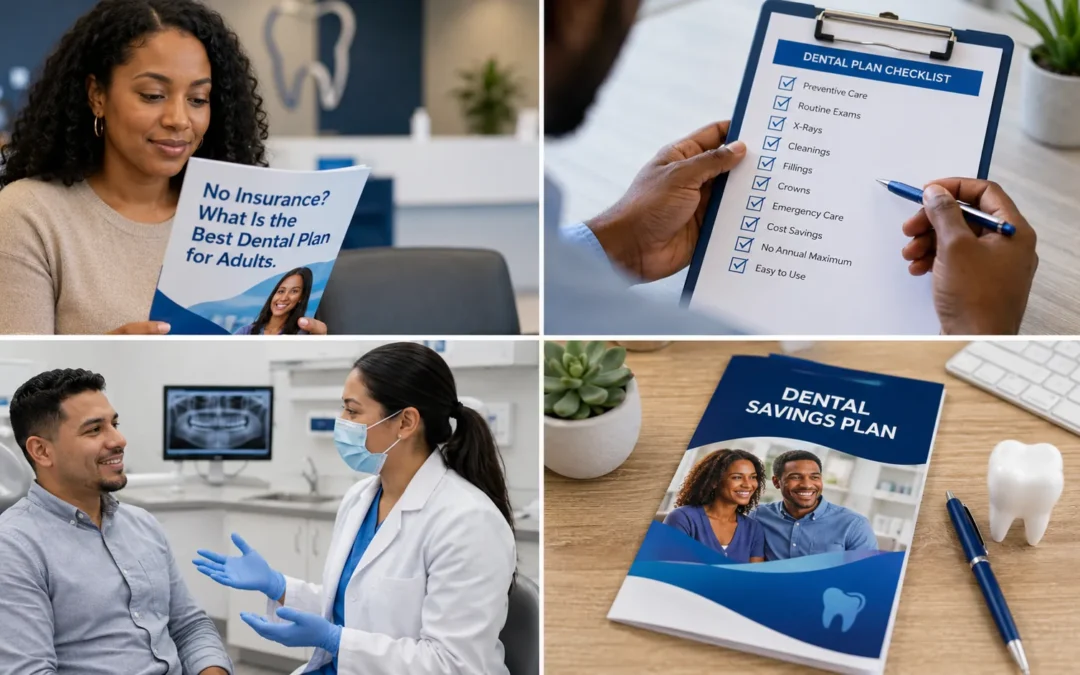
So, what is the best dental plan for uninsured adults? According to the American Dental Association, a substantial share of American adults lack dental coverage, and finding the right option is genuinely confusing. The choices are scattered, the jargon is thick, and it’s easy to land on a plan that sounds affordable until you actually need to use it. At Fancy Smiles Dental Studio, we hear this from new patients every single week: “What’s the best way to pay for dental care without insurance?” The good news is that there are more legitimate paths forward than most people realize.
This guide covers five main routes: standalone dental insurance, dental discount plans, Medicaid and marketplace options, dental schools, and in-house membership plans. By the end, you’ll know which option fits your situation, your budget, and your immediate timeline. No insurance-agent speak, no vague comparisons. Just a clear look at how each option actually works in 2026.
What is the best dental plan for uninsured adults? Start here.
The honest answer is that it depends, on how soon you need care, whether you qualify for assistance, and how much dental work you realistically expect this year. The five options below cover the full range of needs and budgets. Read through each one, then use the cost comparison at the bottom to run the numbers for your specific situation.
Why skipping dental care without a plan always costs more later
The reason most uninsured adults avoid the dentist isn’t laziness. It’s math anxiety. They don’t know what something will cost, so they avoid finding out. The problem is that dental problems don’t stabilize on their own. A cracked tooth or an untreated cavity doesn’t wait for your finances to improve.
Here’s a concrete example: a composite filling in Florida averages around $300 in 2026. Leave that cavity alone for 12 months and you’re likely looking at a crown, which averages $1,137 in Florida and can reach $2,500 depending on the material, roughly eight times the cost of the original filling. That’s not a scare tactic; that’s just how tooth decay progresses. A routine cleaning costs between $75 and $200. Delaying it risks procedures that can cost many times more.
So before comparing plans, anchor yourself to these Florida averages: cleaning at around $138, filling at around $300, crown at around $1,137. Every plan you evaluate either beats those numbers or it doesn’t.
Standalone dental insurance: solid coverage with a catch
Individual dental insurance plans in 2026 typically run $20 to $50 per month in premiums, carry deductibles of $50 to $100, and cap their annual payout at $1,000 to $2,000. That structure works well if you use dental care consistently throughout the year and stay within your network. It works less well if you need something done right now.
Dental PPO vs. HMO: the choice that shapes your experience
A dental PPO gives you the flexibility to see almost any dentist, including out-of-network providers, at a higher premium. A dental HMO ties you to a specific network but costs significantly less per month, often as low as $15 to $25. If you already have a dentist you trust, check whether they’re in-network for any HMO you’re considering before you buy. The monthly savings may not outweigh the disruption of switching providers.
The waiting period problem
Here’s the part that catches most people off guard. Most individual dental insurance plans impose a 6- to 12-month waiting period before they cover major work like crowns, root canals, or bridges. Some plans push that to 24 months for orthodontic work. Among the major carriers, are notably flexible, with several state-specific options that waive waiting periods for preventive care and, in some cases, for major procedures as well.
Waiting periods can sometimes be waived if you have proof of continuous prior coverage, typically 12 or more months of comparable coverage with a gap of no more than 63 days. Requirements vary by carrier, so ask before you enroll. Learn more about how a waiting period works from this .
The bottom line on standalone insurance: it makes sense if you’re planning consistent care over the full year, need orthodontic coverage, or have an employer contributing to your premium. It’s a weaker choice if you need care in the next few months or if your expected annual costs will exceed your plan’s maximum benefit.
Dental discount plans: what they are and where they fall short
Dental discount plans, sometimes called savings plans, are not insurance. They charge a low annual membership fee, typically $100 to $150, in exchange for access to pre-negotiated rates at participating dentists. There’s no deductible, no annual maximum, no claims paperwork. But you pay the full discounted amount yourself at the time of service.
A cleaning that normally costs $200 might be reduced to $140 under a discount plan. That sounds helpful until you compare it to insurance, which often covers preventive visits at 100%, meaning your out-of-pocket for that same cleaning is zero. For routine care, discount plans tend to leave you paying more than insurance does.
Where discount plans fall short on bigger procedures
The math gets harder when major work is involved. A crown discounted from $1,500 to $1,050 still requires you to write a check for $1,050. Standard dental insurance with 50% major coverage on that same crown puts your estimated share closer to $750 after the deductible, though the exact figure depends on your plan’s deductible and coinsurance terms. These are illustrative figures to help you compare structures, not guarantees. Run the actual numbers with any plan you’re considering.
Discount plans are genuinely useful in two specific scenarios: you’re a healthy patient who only needs cleanings and X-rays each year, or you want a discount on cosmetic procedures that insurance won’t cover. If either of those describes you, a discount plan at $100 to $150 per year is a reasonable option. For anyone facing restorative or emergency dental needs, it’s generally not the strongest choice.
Medicaid, marketplace plans, and dental schools: the underused options
These three options don’t get enough attention, and each one serves a different situation. Check all three before spending money on a plan you may not need.
Medicaid: start here if income is a factor
As of 2026, 35 states and Washington, D.C. provide comprehensive adult Medicaid dental benefits covering exams, cleanings, fillings, crowns, root canals, and extractions. Eligibility generally extends to adults earning up to 138% of the Federal Poverty Level, roughly $21,800 per year for a single individual.
Florida falls into the limited-coverage category. Florida Medicaid covers emergency dental services for adults 21 and older, including extractions and infection treatment, but does not cover routine cleanings or exams for the general adult population in 2026. If you live outside Florida or qualify under a disability category, before paying for anything else. It’s often the most underused low-cost option available.
ACA marketplace dental plans
Routine adult dental care is not an essential health benefit under ACA marketplace plans in 2026. Standalone dental plans are available for purchase through the marketplace, but they function like standard insurance, including waiting periods and annual maximums. for 2027 coverage begins November 1, 2026. If you missed the 2026 enrollment window and don’t have a qualifying life event, you’ll need to wait or look at one of the other options in this guide.
Dental schools: real care, real savings
Accredited dental schools in South Florida, including Nova Southeastern University in Fort Lauderdale and the University of Florida’s Miami and Hialeah centers, offer general and specialty dental services at rates well below private practice fees. Published discount ranges vary by school and procedure; contact each school’s clinic directly for their current fee schedule, as no standardized 2026 pricing has been published industry-wide. The trade-off is time. Appointments run longer because licensed students perform the work under direct faculty supervision. For non-urgent care on a tight budget, this is a legitimate and underrated option.
In-house dental membership plans: coverage that starts the day you sign up
Affordable Membership Plans for Dental Care are direct agreements between you and your dental practice, not insurance products. They bundle preventive care into a flat annual fee and include a percentage discount on additional treatments. No waiting periods, no deductibles, no insurance company making decisions about your care. Benefits activate immediately, which makes this the most practical option for anyone who needs care soon.
How in-house membership plans are structured
A typical adult membership plan runs between $200 and $350 per year and includes two professional cleanings, two comprehensive exams, necessary X-rays, and a discount of 10 to 20% on restorative, cosmetic, and emergency procedures. Exact benefits and discount percentages vary by practice, so ask for the full breakdown before enrolling. Because the plan starts immediately and carries no annual cap on the discount benefit, it’s particularly well-suited for uninsured patients who need more than one type of service in a single year.
What Fancy Smiles Dental Studio’s membership plan looks like in practice
At Fancy Smiles Dental Studio in Boynton Beach, FL, the adult membership plan is $299 per year (pricing current as of 2026, contact the office to confirm). It covers two professional cleanings, two comprehensive exams, necessary X-rays, and 15% off all additional treatments. No waiting period, no claims paperwork, no annual maximum confusion.
To illustrate how that plays out: a patient who needs a cleaning and a filling in the same year would pay $299 for the membership plus the discounted cost of the filling. Depending on the filling type and your starting out-of-pocket, that total often compares favorably to paying monthly insurance premiums, meeting a deductible, and then waiting for coverage to kick in. The office can walk you through a side-by-side estimate for your specific situation.
There are also plans for kids at $199 per year and a periodontal plan at $499 per year for patients managing gum disease (contact Fancy Smiles Dental to confirm current pricing). The structure is straightforward: one annual payment, and you know exactly what you’re getting.
What is the best dental plan for uninsured adults? How to decide.
The right answer depends on three factors: how soon you need care, whether you qualify for assistance, and how much dental work you realistically expect this year. Answer those honestly and the decision gets much clearer.
Three questions that point you in the right direction
- Do you need care within the next few months? An in-house membership plan is your most practical option. Most standalone insurance plans won’t cover major work for 6 to 12 months after enrollment, so they don’t help you now. If you have an urgent issue, consult our Dental emergency? Your same-day step-by-step action plan for immediate next steps.
- Do you qualify for Medicaid? Check your state’s coverage before spending any money. If you’re in a state with comprehensive adult Medicaid dental benefits and your income falls near or below 138% of the Federal Poverty Level, you may have free coverage you don’t know about.
- How much dental work do you expect this year? Light users, one cleaning and maybe one set of X-rays, will often come out ahead with a discount plan or membership plan. Anyone expecting fillings, crowns, or other restorative work should compare insurance versus a membership plan carefully. Premiums add up, and annual maximums cap what insurance actually pays.
A quick cost comparison across all five options
Assume you need one cleaning, one set of X-rays, and one filling this year. The figures below are illustrative estimates based on Florida averages and typical plan structures; your actual costs will vary based on your location, specific plan terms, and provider. Use these as a starting framework, not a guarantee.
- No plan (full price): Roughly $570 to $700 in Florida
- Discount plan: $100 to $150 annual fee plus discounted procedures, often $450 to $550 total
- Standalone insurance (PPO): $360 to $600 in annual premiums, plus deductible, with the filling potentially under a waiting period in year one
- Dental school: Substantially reduced rates for all three services, contact the school’s clinic directly for current fees, as published schedules vary
- In-house membership plan (like Fancy Smiles Dental): $299 annual fee covers cleanings and exams, with 15% off the filling, typically $350 to $450 total based on current Florida filling averages
The right path forward is closer than you think
Asking what is the best dental plan for uninsured adults doesn’t have one universal answer. What works for a healthy 28-year-old who wants annual cleanings is different from what works for a 52-year-old who hasn’t seen a dentist in three years and suspects they need restorative work. The five options in this guide, standalone insurance, discount plans, Medicaid, dental schools, and in-house membership plans, cover the full spectrum of needs and budgets.
Start with what’s most urgent. If income is a factor, check Medicaid eligibility first because it costs nothing. If you need care soon and want a predictable annual cost with no insurance paperwork, an in-house membership plan is worth a serious look. If your dental health is solid and your needs are minimal, a discount plan or dental school may serve you well enough.
At Fancy Smiles Dental Studio, we help uninsured patients work through this every day. Dr. Francesca Scarlett and our team walk you through your options and match you with a payment approach that makes sense for your mouth and your budget. There is always a workable path, one that doesn’t require you to put off care indefinitely. Give us a call or stop by our Boynton Beach office, and let’s build a plan that works for you.
Frequently asked questions
1. What is the best dental plan for uninsured adults in 2026?
It depends on your timeline and budget. If you need care immediately, an in-house membership plan is typically the strongest option, benefits start the same day with no waiting periods. If you qualify based on income, Medicaid is the first place to check because it may cost nothing. For healthy patients who mainly need preventive care, a dental discount plan or dental school can work well. Standalone insurance makes the most sense if you want comprehensive coverage over a full year and can handle the waiting period for major work.
2. Are dental discount plans the same as dental insurance?
No. Dental discount plans are membership programs that give you access to reduced rates at participating dentists. You pay the discounted fee in full at the time of service. There are no claims, no deductibles, and no annual maximums, but also no shared cost. Dental insurance, by contrast, pays a portion of your covered treatment costs after you meet a deductible.
3. Can uninsured adults get Medicaid dental coverage?
Possibly, depending on your state and income. As of 2026, 35 states and Washington, D.C. offer comprehensive adult Medicaid dental benefits. Florida covers emergency dental services only for most adults. to confirm what’s available where you live.
4. How long are waiting periods for dental insurance?
Most individual dental plans impose a 6- to 12-month waiting period before covering major work such as crowns, root canals, or bridges. Some plans extend that to 24 months for orthodontics. Waiting periods may be waived if you can show proof of continuous prior coverage, typically 12 or more months with no gap longer than 63 days, but waiver rules vary by carrier. For a plain-language overview of waiting periods, see this .
5. What does Fancy Smiles Dental Studio’s membership plan include?
The adult plan at Fancy Smiles Dental Studio in Boynton Beach, FL is $299 per year and includes two professional cleanings, two comprehensive exams, necessary X-rays, and 15% off all additional treatments. There’s no waiting period and no annual maximum on the discount. Plans for children ($199/year) and a periodontal plan ($499/year) are also available. Contact the office to confirm current pricing and availability. Learn more about our Affordable Membership Plans for Dental Care.
6. Is a dental school a safe place to get dental care?
Yes. Accredited dental schools have licensed students perform procedures under direct supervision from experienced faculty dentists. The care meets the same clinical standards as a private practice. The main trade-off is time, appointments tend to run longer than in a typical office. For non-urgent treatment on a tight budget, dental schools are a legitimate and often overlooked resource.