


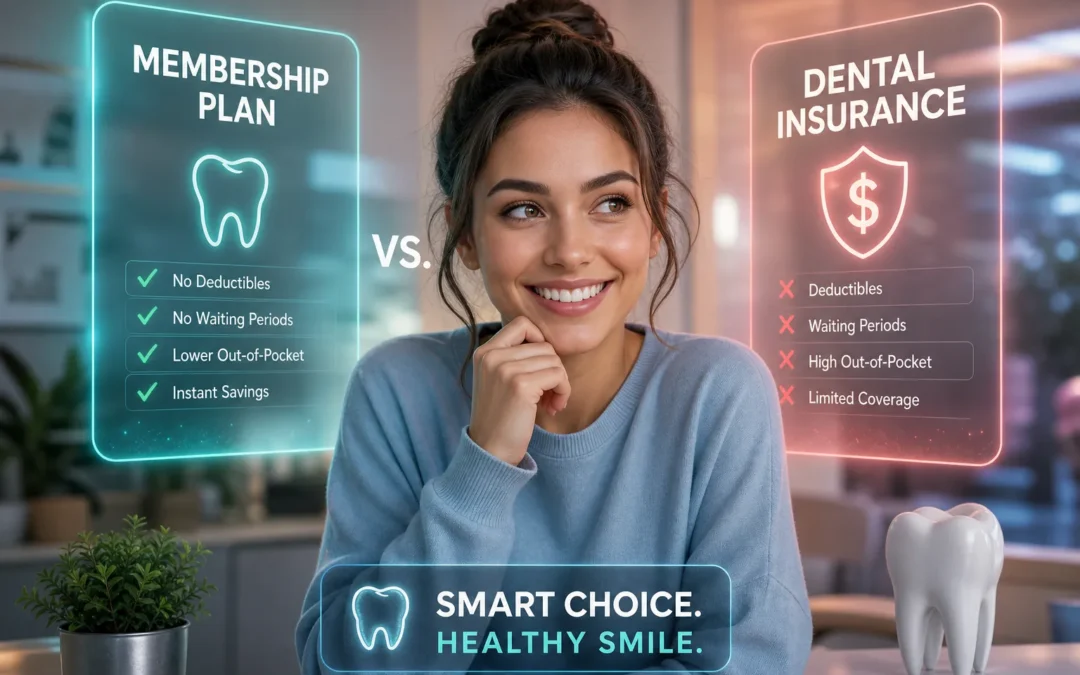
Many uninsured adults assume dental insurance is the responsible default. But putting a dental membership plan vs. insurance side by side tells a different story. A standard individual dental PPO can run $977 to $1,200 a year in premiums alone, figures associated with comprehensive PPO coverage, while the annual maximum benefit has stayed flat at $1,000 to $1,500 for several decades, never keeping pace with inflation or rising procedure costs. Meanwhile, in-house dental membership plans like the adult option at Fancy Smiles Dental Studio in Boynton Beach start at $299 a year.
Before you hand over money to either option, you need to see what you’re actually buying. Not the marketing language. The real numbers, the real rules, and the real gaps. That’s what this breakdown gives you.
How traditional dental insurance actually works
Dental insurance follows a tiered coverage structure known as the 100-80-50 rule. Preventive care, cleanings, exams, and X-rays, gets covered at 100%. Basic care, which includes fillings and extractions, comes in at roughly 80%. Major work such as crowns, root canals, and bridges gets covered at about 50%. That sounds reasonable until you apply it to real procedure costs.
Take a porcelain crown priced at $1,500. At 50% coverage, your insurance pays $750. But first you need to meet your deductible, typically $50 to $150. And if you’ve already used some of your annual benefit earlier in the year, your insurance might cover far less than that $750 figure suggests. A crown plus root canal on a molar can easily run $2,000 to $3,500 total. Once you hit your annual maximum, insurance stops paying entirely. Every dollar after that comes out of your pocket.
The annual maximum is where dental insurance shows its age. Most caps fall somewhere in the $1,000 to $2,000 range, a ceiling that hasn’t kept pace with several decades of inflation or rising dental costs. A single major procedure can blow past that cap before the calendar year ends. After that, you’re effectively uninsured again, despite paying premiums all year. For background on how annual maximums affect out-of-pocket exposure, see the discussion on what is dental insurance annual maximum.
Waiting periods compound the problem. Most individual dental PPO plans impose a six-month waiting period on basic work and a full twelve months on major procedures. Preventive care is typically available from day one, but that’s the only category. Sign up in January, crack a tooth in February, and you’re waiting until the following January for crown coverage to kick in. For an overview of common dental insurance waiting periods, check typical plan rules before you enroll.
Dental membership plan vs. insurance: what the membership side actually offers
An in-office dental membership plan works differently at the structural level. You pay one flat annual fee directly to your dental practice. No insurance company is involved, no claims get filed, and no reimbursement process exists. The fee covers a defined set of preventive services and gives you a percentage discount on everything else.
The mechanics are simpler than most people expect. Your annual fee includes services like cleanings, exams, X-rays, and fluoride treatments. Any treatment beyond that bundle gets priced at a discount from the practice’s standard fees. There’s no deductible to meet first and no annual maximum standing between you and your care. According to various industry surveys, somewhere between 25% and 40% of dental practices now offer some version of this dental membership savings model, so it’s no longer a niche option. Recent reporting highlights how dentists are increasingly offering membership plans to address uninsured patients’ needs; see coverage on dentists offering membership plans for more context: dentists chip away at the uninsured problem by offering membership plans.
Many in-office membership plans carry no waiting period, and that’s often the single biggest practical advantage over traditional coverage. If you need a filling or a crown the same week you enroll, you get the discounted rate immediately, with no twelve-month delay and no coverage denial for pre-existing conditions. Your discount applies to every procedure regardless of how much you’ve spent that year. Always confirm the specific terms with your practice before enrolling, since a small number of plans do impose short waits on major procedures.
The discounts on common procedures are worth knowing. Across well-structured plans, adult cleanings typically run 50 to 63% off standard fees. Composite fillings see savings in the 52 to 58% range. A molar root canal can come down 56 to 61% from full price. Porcelain crowns tend to fall 52 to 58% below the standard rate. These numbers vary by practice, so always confirm before you enroll. For additional industry analysis on dental benefits and the cost of serving enrollees, see the NADP’s data perspective: new data on dental benefits and cost of serving enrollees.
Dental membership plan vs. insurance: running the real numbers
Two scenarios cover most of the population: patients who only need preventive care, and patients who need one major procedure during the year.
Preventive-only scenario
For a healthy-mouth patient, the comparison is straightforward. A comprehensive individual PPO premium runs $977 to $1,200 per year. Two adult cleanings and exams paid out of pocket cost roughly $400 to $500 in most markets. A dental membership savings plan covering those same two cleanings typically runs $200 to $400 annually as a flat fee. For someone who needs only preventive care, the membership plan beats insurance by $200 to $400 every year, and paying fully out of pocket is competitive too. If you’re weighing home care against professional visits, see Home Remedies Vs Professional Dental Treatments | Fancy Smiles for guidance on when professional care is necessary.
Major-procedure scenario
The math shifts when major work enters the picture. A root canal plus crown totals $2,000 to $3,500 at full price. Under a standard PPO, you might owe roughly $1,500 after the plan pays its 50% share and you’ve hit your annual maximum. Under a membership plan with a 55% discount, the same treatment could run $900 to $1,575, depending on the practice’s standard fees. In a high-cost major procedure year, insurance can still reduce your bill more than a membership plan, but only if your total treatment cost pushes past the annual maximum, meaning insurance paid out enough to actually justify the premium you spent all year.
Neither option is free. The question is which one matches your actual usage pattern, not your worst-case fear. That’s the core of the dental membership plan vs. insurance comparison: match the product to your real annual needs, not the theoretical worst day.
A membership plan done right: Fancy Smiles Dental Studio’s in-house option
Fancy Smiles Dental Studio in Boynton Beach offers a clear example of what a well-built in-office dental savings plan looks like. The practice runs three tiers: Kid at $199 per year, Adult at $299 per year, and Perio at $499 per year. Each plan includes two cleanings, exams, X-rays, and fluoride treatments. Members receive 15% off any additional treatments, with no annual maximum and no waiting period. (Contact the practice directly to confirm current plan terms before enrolling.) For details on the practice’s offerings, view their Affordable Membership Plans for Dental Care.
The math on the adult plan is simple. At $299 a year, you’re paying roughly $25 a month, less than many patients pay monthly toward insurance premiums or cost-sharing on a single procedure. That covers your full preventive care package from day one. You know your cost before you sit down, with no claim to file and no deductible to hit first.
Many uninsured adults skip the dentist not because they’re afraid, but because the cost feels unpredictable. A flat annual fee removes that uncertainty. The Fancy Smiles membership structure reflects a clear philosophy: you should be able to walk in, get excellent care, and know exactly what you owe. That’s the dental savings plan model working as it should, without an insurance company sitting in the middle of every transaction.
Which option actually fits your situation
When weighing a dental membership plan vs. insurance for your specific circumstances, dental insurance still makes sense in certain cases. If your employer covers most or all of your premium, the math changes significantly because you’re not paying $1,200 a year out of your own pocket. If you expect multiple major procedures in the same plan year, a PPO with a high annual maximum can offset treatment costs meaningfully. Families with complex dental histories that regularly generate more than $2,000 in annual treatment bills should take a close look at whether a PPO’s benefit structure actually covers enough to justify the premium.
A dental membership plan makes more sense in a different set of scenarios:
- You’re uninsured and your mouth is in reasonably good shape
- Your care needs are mainly preventive with occasional basic work
- You want to start treatment immediately, not after a twelve-month waiting period
- You want to know your annual dental cost before January ends
- You’re comparing a third-party dental discount card against an in-office plan, in-office plans often offer better savings and simpler terms
Before you commit to either option, run through a short decision sequence. Estimate your likely procedures for the next twelve months, being realistic about whether you have known restorative needs or are mostly a routine care patient. Then calculate what you’d actually pay in premiums plus deductible under a PPO. Ask your dental office whether they offer an in-house membership plan and what it covers. Finally, compare the two dollar amounts directly, not the coverage percentages, but the actual out-of-pocket total for your specific situation. The percentage comparisons look clean on paper. The dollar amounts tell the real story.
The bottom line
Dental insurance isn’t broken. It just doesn’t work the way most people assume, and for many uninsured adults, the premium cost relative to the capped benefit doesn’t add up. The dental benefits comparison becomes clearest when you use your own numbers rather than average scenarios.
For a healthy adult in Boynton Beach who wants reliable preventive care and the ability to handle occasional treatment at a fair, predictable price, the in-office dental membership at Fancy Smiles Dental Studio is a concrete starting point. At $299 a year with no waiting period, no annual cap, and transparent pricing on every procedure, it removes most of the frustration that keeps people from seeing a dentist regularly.
The choice between a dental membership plan and insurance comes down to one question: what do you actually expect to need this year? Answer that honestly, run the numbers, and the right option becomes obvious. If you’re in the Boynton Beach area and want to talk through whether the Fancy Smiles membership plan makes sense for you, the practice is accepting new patients. Start there. For an additional perspective on choosing the right coverage when you’re uninsured, see Best Dental Plans for Uninsured Adults: Your 2026 Guide.